Get Steady Now

Get your body back first.

You can know exactly how you want to respond to the people you love and still not have the room to do it. That room is physical. Four hours of sleep, a sugar crash and a phone buzzing at midnight shrink it before anything even happens. So we start with what you can touch.

Free. No signup. Nothing you type leaves this page.

In…

Notice anything? That's the room you need. Now use it.

I'm in it right now →
See it: the gap

What you feel. What you do. The space between.

What I feelWhat I do

That gap is where emotional intelligence lives. It's the moment you notice the anger and choose your words, or feel the urge to shut down and stay in the room anyway. You can't out-think a gap that isn't there.

An illustration, not a measurement. Your choices stay in this open page.

01 · In it

Hit the brakes first.

These won't fix the root cause yet. They buy you a few seconds between what you feel and what you do.

8 minutesnew

I Need 8 Minutes

Use it when you need to walk away without walking out.

"I told her that I needed 8 minutes. I stepped outside. My body and brain were buzzing with tension."

A guided break that ends with the sentence you'll say when you walk back in.

Take my 8 minutes →
30 secondsright here

The physiological sigh

Use it when her tone changes and you feel your chest go tight before you've said a word.

Two breaths in through the nose, one long breath out. Three to five times. Keep it comfortable and stop if you feel lightheaded.

Do it now →
1 minuteGreg's voice

The One-Minute Reset

Use it when you need someone to talk you down and nobody's there.

One minute, my voice or words only. The page goes dark and quiet while you do it.

Start the minute →

"Using them is like building a new dirt path through the forest when there's a fight-or-flight freeway right next to it. The more you walk it, the easier it gets."

Greg Donihoo · Matter Over Mind, Chapter 2

Why practice when you're calm: in the heat of the moment your body reaches for whatever it's practiced most. The tool you actually use will always beat the perfect one you forgot.

02 · After

You can lose it and still repair.

It's too easy to say "I'm sorry" and have no idea why it happened or what to do next time. These get you curious instead of ashamed.

5 minuteson paper or out loud

The Setback Reset

Use it when it went sideways an hour ago and you're still replaying it.

Five steps that turn "what's wrong with me" into "what was that part of me trying to protect."

Walk through it →
10 minutesbefore you talk

COAR

Use it when you're about to go back in and apologize, and you want it to actually land.

"I stopped making it about a dirty pan and started making it about my pattern of lying as a first instinct."
Plan the repair →
The Setback Reset

The Setback Reset

Five steps to get curious about what happened. A few words are enough.

Let your breathing be comfortable. What do you notice in your body?

What feeling or reaction showed up?

What might that part of you have been trying to protect?

When else has this feeling been familiar?

What did you need then, and what do you need now?

Your answers stay in this open page. From Matter Over Mind, Chapter 2.

COAR: plan the repair

COAR: plan the repair

Clarify. Own. Apologize. Remedy. Start with one specific incident and your part in it.

What happened? What do you know, and what did you assume?

What did you do or fail to do? How did it affect the other person?

Name the specific harm in your own words.

What will you change, by when, and how will anyone see it?

Your answers stay in this open page. From Matter Over Mind, Chapter 2.

03 · Before

Train when the stakes are low.

You wouldn't learn self-defense in the middle of a fight. Breath, body, brain: pick one of each and do it on a schedule.

1 to 10 minutesbreath

The Breathing Studio

Use it first thing in the morning, before the day gets a vote.

"My mood and confidence jump 20 to 30 percent for at least a few hours, and there's more room between whatever hits me and how I react."
Open the Studio →
7 daysbody

The Sit

Use it when you can't remember the last time you sat still without your phone.

A small attention practice you repeat for a week. It gets easier by day four.

Start day one →
3 to 5 minutesbrain

Quiet My Mind

Use it when it's midnight and your head won't shut off.

"Thoughts that stay in your head loop. Get them out." Put the loop on paper and give yourself a place to stop.

Empty my head →
Take it with you

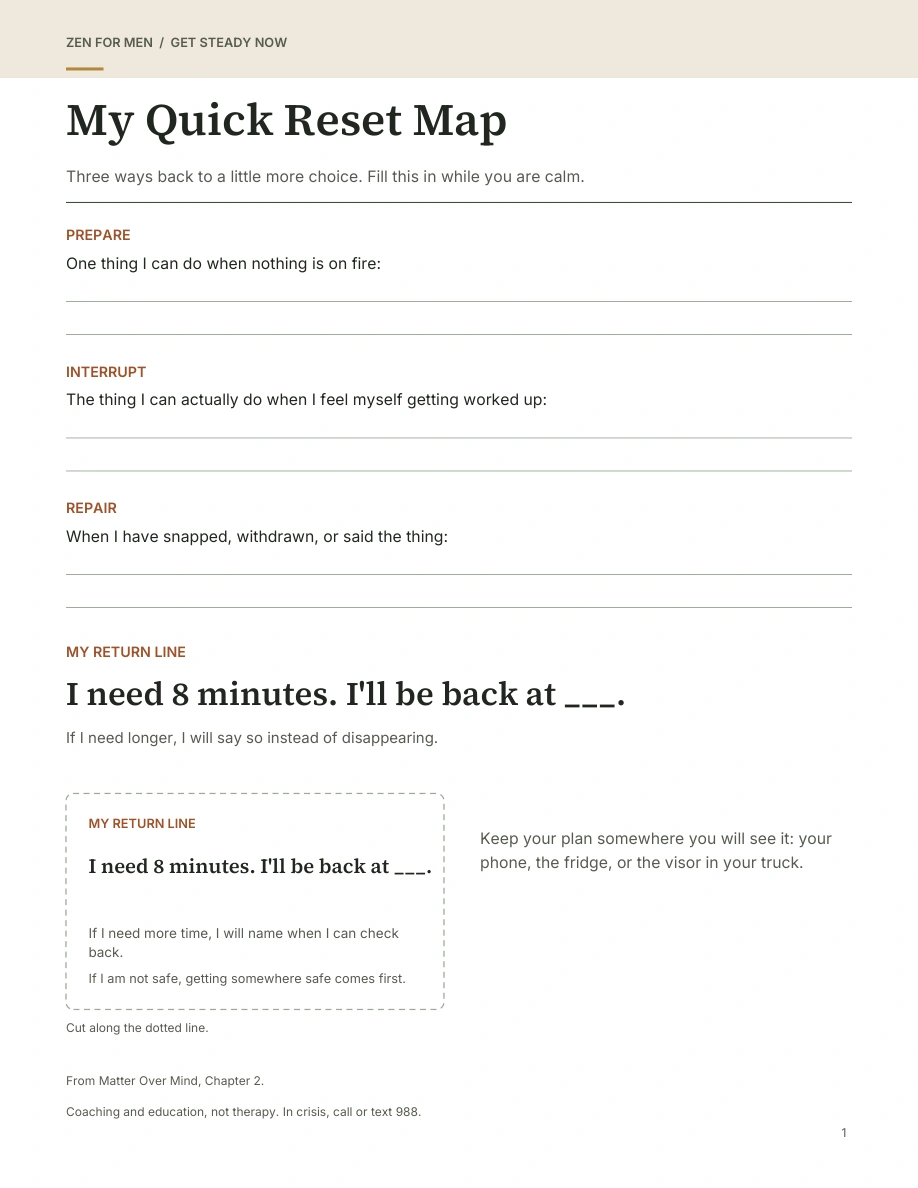
Put your plan on the fridge.

One page with your Prepare, Interrupt and Repair picks, your return line, and a wallet card you can cut out. Page two is Know Your Tells: the signs you're losing it, before you know why.

Download the PDF →
Next door · Build New Habits

If the same thing keeps knocking you over, look at what you keep reaching for.

What is it promising you? →

The physiological sigh

Thirty seconds. Three comfortable rounds.

First inhale, a small second inhale, then a longer breath out. Keep it easy. Stop if you feel lightheaded.

Breathe normally until you're ready.

I Need 8 Minutes

Step away without walking out.

Tell them you’re not leaving. You’re coming back. This practice uses timed words; Greg’s recording will be added when it arrives.

What happened with the pan

I used a dirty pan. I didn't think it was a big deal. It was oil and a single mushroom from that morning. I just turned the heat back on.

She noticed. And she asked me about it. I could tell in her tone that she would not be happy with that. “Did you use the pan from this morning?” “No,” was my quick response, thinking fast.

She didn't believe me. She pressed and I caved. I felt panic and anger all at once. I told her that I needed 8 minutes. I stepped outside.

Greg Donihoo · Matter Over Mind, Chapter 2

If you're afraid of being hurt, you don't owe anyone a return time. Go somewhere safe. Relationship safety resources

Your words stay in this open page. You can skip anything, pause, or finish early.

One practice a week, by email. Free. Get One Rep